Influence Machine(s)
Typically, at the end of the day, my wife and I lie in our dark bedroom and fall into the rabbit hole of doom-scrolling social media. Like many people, we find it addicting, entertaining, and at times disturbing — an endless stream of cat videos, news updates, food influencers, artists’ work, prank videos, and advertisements delivered through the small glowing brick in our hands. We both recognize this is probably not the healthiest way to end the day before falling asleep, but it is difficult to resist. These platforms were intentionally engineered to be habitual. The act of scrolling itself reduces engagement to something nearly frictionless: a thumb moving upward while the eyes passively consume. Every other part of the body becomes irrelevant. There is even a way that allows users to scroll by blinking.
I am reminded of an illustration from 1899 depicting Dr. J. Leonard Corning’s proposed “sleep laboratory,” an apparatus intended to induce pleasant dreams through projected colored patterns and musical vibrations transmitted by wires directly through a nightcap. I find the imagery humorous because of how invasive and uncomfortable it appears — the sleeper surrendering themselves to a machine that resembles an alien-probe experiment more than a medical device. Yet presentism has taught us to be cautious about adopting new technologies too quickly. We often recognize their unintended consequences much later, after they have already become normalized and ubiquitous.
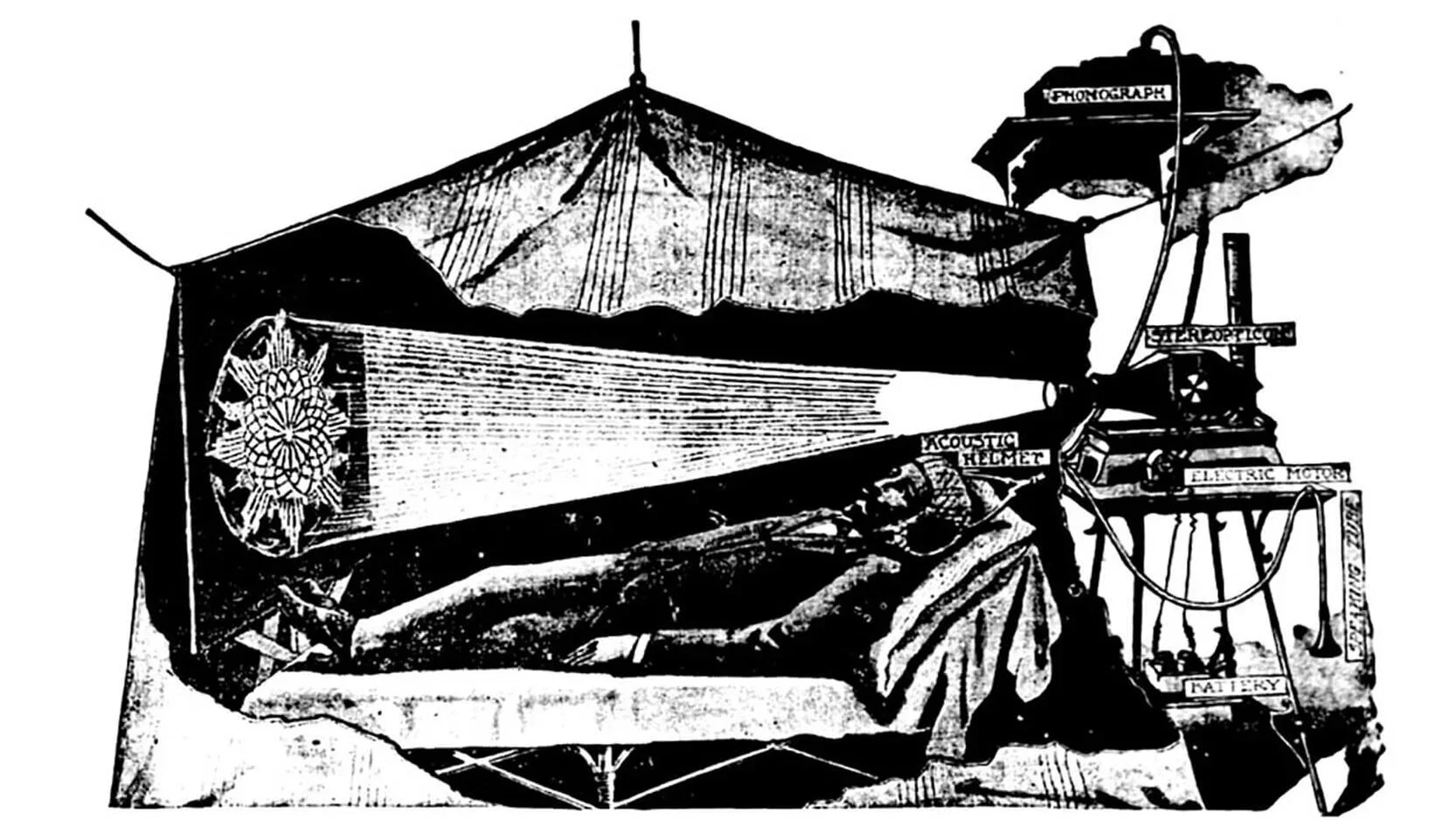
J. Leonard Corning’s tent for inducing pleasant dreams. Illustration from the St Louis Post-Dispatch, 4 June 1899.
Popular media repeatedly imagines the dangers of surrendering ourselves to screens and simulated realities. I think of the hover chairs in WALL-E (2008), where humans become so attached to their screens that they no longer look outward. I think of The Matrix (1999), where Neo awakens from a fabricated reality sustained entirely through illusion and control. Or A Clockwork Orange (1971), where Alex is forcefully conditioned through a barrage of violent imagery and Beethoven, turning cinema itself into a tool of psychological reprogramming. More recently, I was struck by an episode of The Mandalorian (2019) in which the New Republic employs a “mind flayer” device to rehabilitate former Imperials. Even the supposed “good guys” weaponize technology for ideological conditioning.

People in hover chairs glued to their screens. Still from Wall-E, 2008.

Neo waking up from his fabricated reality. Still from The Matrix, 1999.
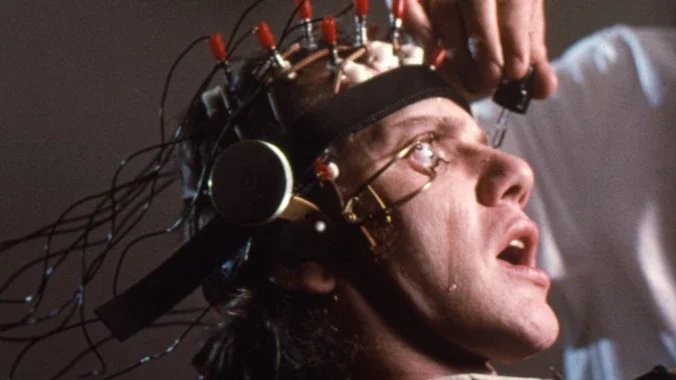
Alex forcefully being fed imagery and music. Still from A Clockwork Orange, 1971.
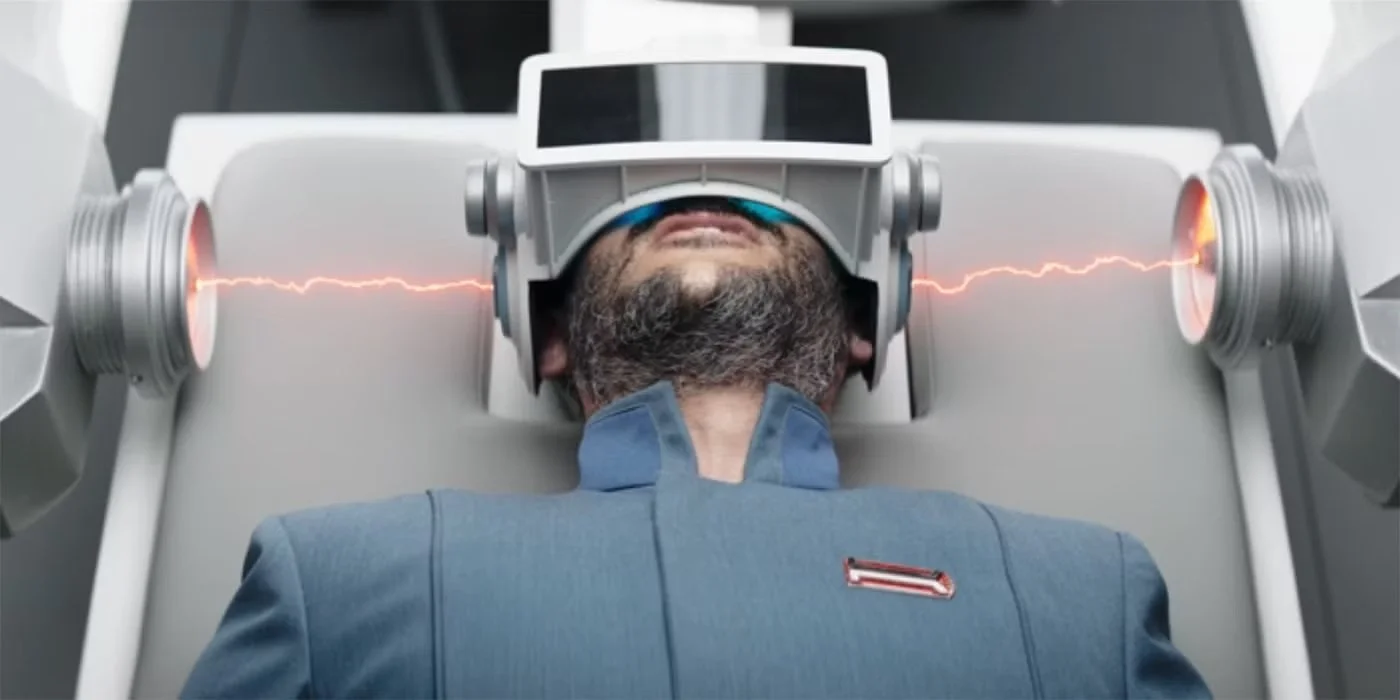
Past Imperialist being mind flayed. Still from The Mandalorian (2019)
These examples may come from dystopian fiction, but they point toward something very real: imagery possesses power, and editing or sequencing imagery may possess even greater power. Sergei Eisenstein understood this through montage theory — that meaning and emotion emerge not simply from images themselves, but from the collision between them. Modern algorithms can function similarly, constructing emotional and ideological rhythms through endless subjective sequencing. There are countless historical examples of media being used to manipulate behavior and emotion. Conversion therapies in the 19th century employed homoerotic imagery alongside nausea-inducing drugs in attempts to create aversion responses. Charities pair emotionally devastating footage with sentimental music to encourage donations — Sarah McLachlan’s “Arms of an Angel” becoming inseparable from images of abused animals. Pixar movies are seemingly designed to make children (and adults) cry.
We as viewers today possess a greater degree of agency than audiences in earlier forms of mass media, yet manipulation still quietly structures our experience. Social media platforms, films, advertisements, games, and news feeds all compete within an attention economy where emotional engagement translates into profit. Algorithms become subjective feeding machines, optimizing content to keep us watching while flattening complexity into digestible fragments. Over time, this relationship becomes so ubiquitous that it begins to feel natural.
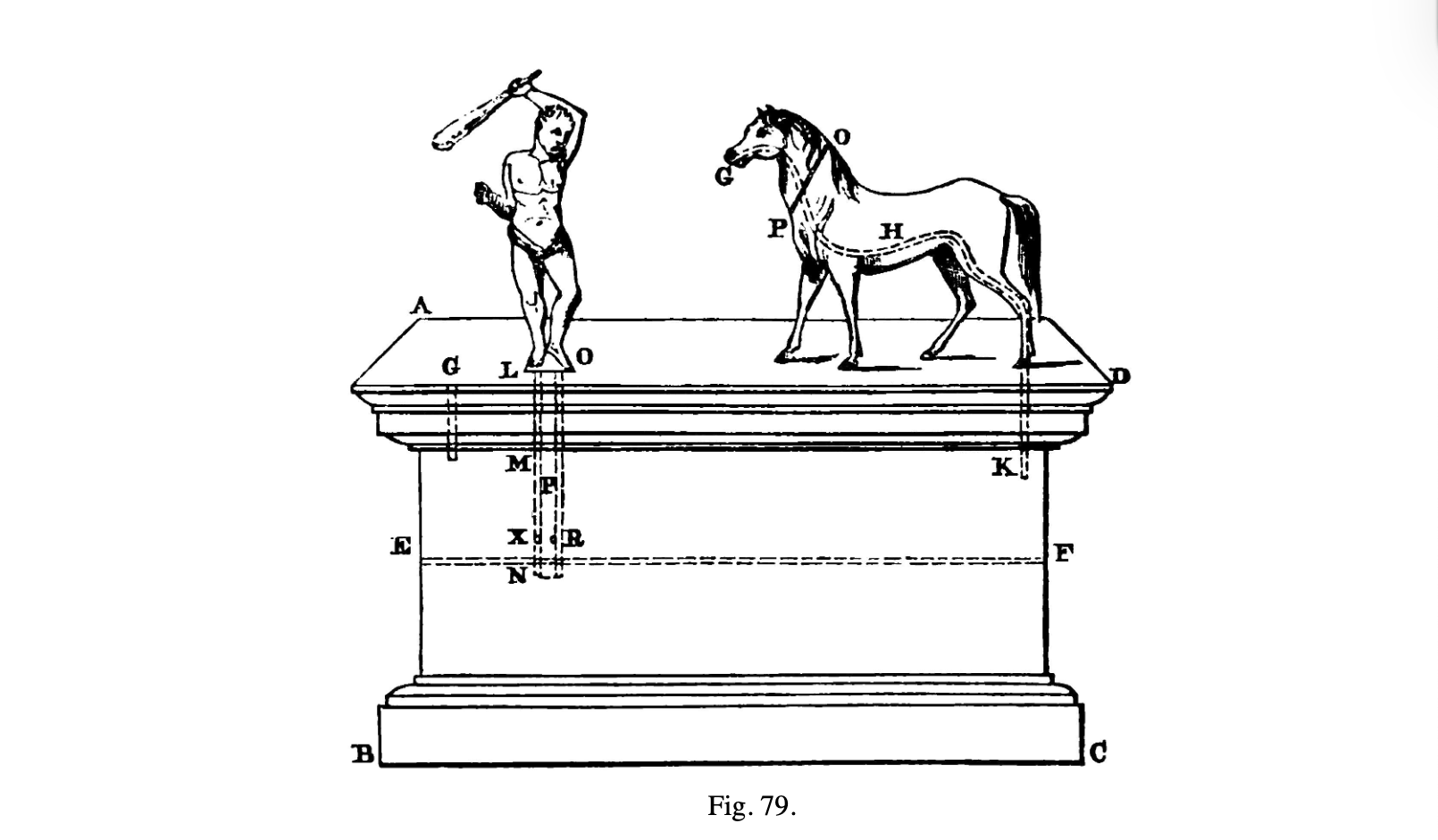
An interpretation of the beheaded animal automaton. Illustration from the Bennet Woodcroft translated version of The Pneumatics of Hero of Alexandria, 1851.
Yet this type of machine-driven manipulation is not unique to our digital age. The technologies may change, but the underlying relationship between spectacle, belief, and control persists across history. In ancient Greece, Hero of Alexandria reportedly designed a mechanical animal that appeared to survive decapitation and continue drinking afterward. Temple speakers allegedly used such automata to convince audiences that divine forces were present. It is speculated these demonstrations occurred in darkened temple interiors where hidden mechanisms could not easily be detected, allowing technology to exploit fear, awe, and belief (If you’re interested more on this sort of topic, there is a documentary called Ancient Discoveries: Machines of the Gods (2007) that proved to be an entertaining and insightful watch). The Wizard of Oz (1939) immediately comes to mind: the terrifying all-powerful wizard revealed to be merely a clever inventor concealed behind a curtain, orchestrating spectacle through machinery and illusion.Early cinema provides another example. L'Arrivée d'un train en gare de La Ciotat (1896), the famous 50-second Lumière brothers film documenting a train arriving at a station, was rumored to have frightened audiences into thinking the train would burst through the screen. Though historians debate whether this reaction actually occurred, the persistence of the myth is revealing in itself. Even at cinema’s birth, people understood the moving image as something capable of overwhelming the senses and collapsing distinctions between reality and representation.
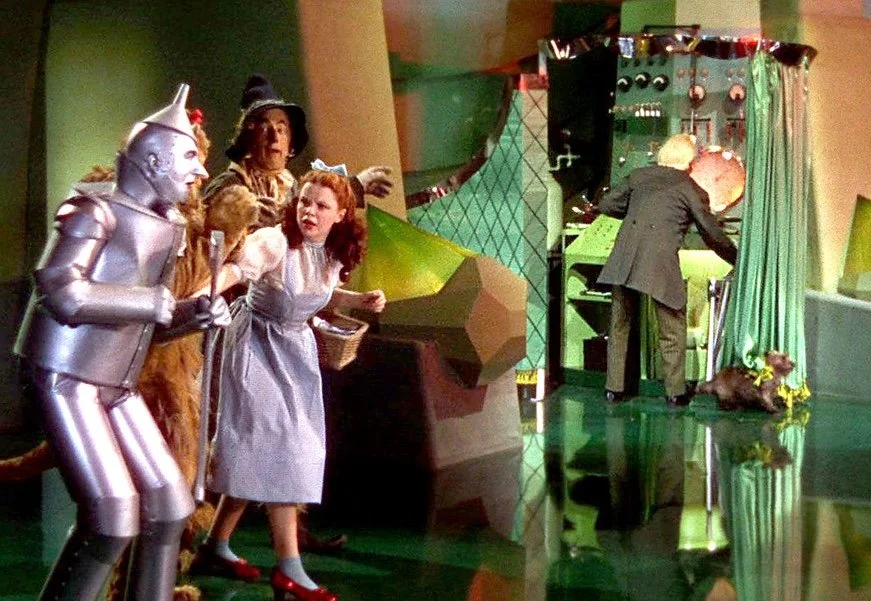
Discovering the man behind the curtain. Still from The Wizard of Oz, 1939.

Train arriving at the station. Still from L'Arrivée d'un train en gare de La Ciotat, 1896.
I do not think these machines are inherently good or evil. Projection technologies, cinema, algorithms, optical illusions, social media — they are all extensions of humanity’s desire to simulate, persuade, entertain, and create order. What unsettles me is not necessarily the existence of these systems, but how easily they disappear into normalcy once they become integrated into everyday life.
So perhaps doom-scrolling in bed is not some unprecedented collapse of human attention, but simply the latest iteration in a much older history of engineered spectacle. The glowing screen in my hand is not entirely different from the darkened temple, the cinema theater, or the mechanical illusion hidden behind a curtain. The technologies evolve, but the relationship between image, machine, and human vulnerability remains strangely familiar.